




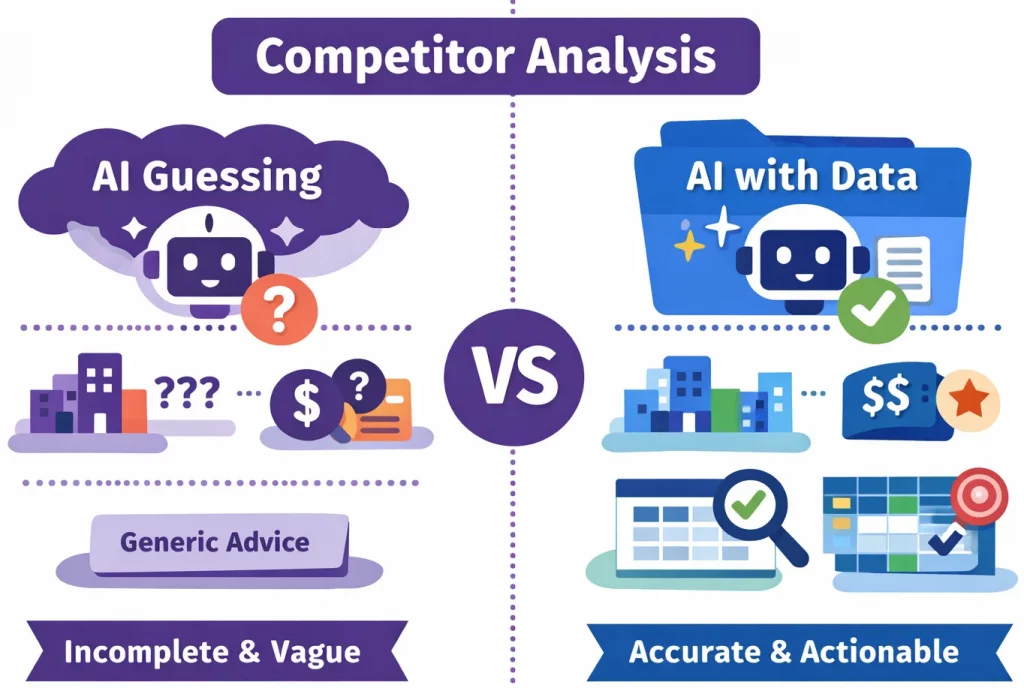
Most competitor analysis today looks like this:
Someone opens ChatGPT, types “analyze my competitors,” reads a confident answer, and assumes they now understand the market.
But that is not analysis.
It is a language model producing patterns from its training data, not from what your competitors are actually publishing right now.
The real improvement does not come from writing better prompts.
It comes from giving AI real information to analyze.
This article explains a practical workflow built around three steps:
- Discover competitors through Google search data
- Extract the full content of their websites
- Run structured AI analysis on the collected data
This approach uses Hexomatic for data collection and AI models for interpretation.
Why “AI-Only” Competitor Research Often Fails
When an AI model is asked to analyze competitors without being provided current data, several predictable problems appear.
Typical outputs include:
- Estimated or fabricated pricing
- Missing competitors that actually rank in search today
- Generic market positioning categories
- Advice that sounds intelligent but could apply to almost any business
The reason is simple.
Large language models do not browse the web during a normal conversation.
They rely on historical training data, which means they rarely contain:
- Local market competitors
- Newly launched businesses
- Updated service offerings
- Current messaging on company websites
The response may sound convincing, but it is often detached from the real market.
Real analysis requires real inputs.
Step 1: Identify Competitors Through Google Search Data
Do not begin with a list of companies you already know.
Start with the place where customers begin their research: Google search results.
Inside Hexomatic, run the Google Search Scraper automation and provide a list of industry queries.
Example for a grill cleaning company:
- grill cleaning miami
- bbq cleaning service miami
- grill repair miami
- outdoor kitchen cleaning miami
- grill maintenance miami
For every query, Hexomatic collects:
- Website URL
- Business name
- Page title
- Description snippet
- Search ranking position
Running multiple search queries quickly produces a real market snapshot.
In most cases, 5–10 searches reveal 15–25 competitor domains that deserve analysis.
This step matters because search results represent what potential customers actually see in the market right now.
It removes bias and assumptions from the competitor list.
Step 2: Crawl and Extract Competitor Website Content
Once the domains are collected, the next step is to analyze what competitors are actually publishing.
Instead of manually browsing websites, use Hexomatic’s Website Crawler.
The crawler scans each domain and maps all publicly accessible pages, including:
- Service pages
- Location pages
- FAQs
- pricing sections
- blog content
- promotional landing pages
This often reveals pages that would otherwise go unnoticed.
For example:
- seasonal offers
- niche service packages
- coverage area breakdowns
- specialized service descriptions
After collecting all URLs, send them to the Page Content Extractor.
This automation pulls the human-readable text from each page, including:
- headings
- paragraphs
- lists
- tables
- service descriptions
No HTML parsing is required.
The output becomes a structured dataset containing:
- company name
- page URL
- extracted website content
Now every competitor’s messaging, positioning, and claims exist in one place.
Step 3: Use AI to Analyze the Real Dataset
Once the data is collected, AI becomes extremely powerful.
Instead of guessing, the model reads the exact content competitors publish.
Export the scraped dataset and feed it into an AI model such as GPT or Claude.
The key is to use structured prompts that force the model to stay within the data.
Prompt 1: Generate Individual Company Profiles
Ask the AI to summarize each company using only the extracted content.
Example structure:
For each company in the dataset summarize:
- Services offered
- Pricing style (packages, quotes, transparent pricing)
- Brand positioning and tone
- Service area
- Trust signals such as reviews or guarantees
- Differentiators mentioned on the website
Important instruction:
Use only the provided dataset. If a detail is missing, write “not found.” Do not infer.
Prompt 2: Build a Competitor Comparison Table
Next, generate a structured comparison.
Example columns:
Services | Pricing approach | Guarantees | Coverage area | Differentiators | Brand tone
This table instantly reveals how competitors present themselves.
Patterns become visible quickly.
Prompt 3: Detect Market Gaps
Now ask the model to identify opportunities.
Example instruction:
Based on the comparison table, identify five opportunities where [your company] could differentiate.
Organize them into:
- messaging gaps
- product or service gaps
- trust gaps
Require the model to cite examples directly from the dataset.
This forces the insights to remain grounded in reality.
Prompt 4: Create Alternative Positioning
Finally, ask the AI to generate possible positioning angles for your business.
Example instruction:
Using the dataset, propose three positioning strategies not currently used by competitors.
Each proposal should include:
- a one-sentence positioning statement
- supporting evidence from competitor messaging
Again, require the model to rely strictly on the dataset.
What Changes When AI Receives Real Data
A simple experiment shows the difference.
First prompt the AI with no dataset:
Then repeat the prompt with your scraped data attached.
The difference is immediate.
Data-driven analysis will:
- quote competitor language directly
- reveal pricing structures competitors actually use
- show overlapping positioning strategies
- identify real market gaps
The AI did not become smarter.
It finally had something real to analyze.
Setting Up the Workflow in Hexomatic
The entire process is straightforward:
- Run the Google Search Scraper with your search queries
- Crawl competitor domains with the Website Crawler
- Extract page text using Page Content Extractor
- Export the dataset to CSV
- Run structured analysis with AI
The initial setup takes around 15 to 20 minutes.
After that, it can be repeated quarterly to monitor how competitors evolve.
Responsible Web Data Collection
This workflow targets only publicly available pages, including:
- homepages
- service descriptions
- pricing pages
- FAQ sections
It does not access private content or login-protected areas.
Hexomatic also includes built-in rate limiting to avoid overwhelming websites.
If a domain blocks crawling through robots.txt, it should be skipped.
Responsible scraping protects both your data and the broader web ecosystem.
Prefer a Done-For-You Setup?
If you want the results without building the workflow yourself, Hexomatic offers a Concierge Service.
Provide your industry and target market, and the team will handle:
- search data collection
- website crawling
- content extraction
- dataset delivery
For larger projects involving multiple markets or continuous monitoring, you can also schedule a consultation to design a custom data pipeline.
Final Thought
AI becomes useful when it analyzes evidence, not guesses.
Competitor analysis built on scraped market data turns vague insights into concrete strategy.
And once the workflow is set up, the process becomes repeatable, measurable, and far more reliable than prompt-based research.